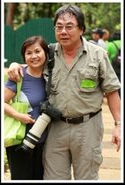
While Kathy, John G and I were walking towards Mother Care at
the Fort, we chanced upon a former Adphoto employee whom I had not seen since
he left, about five years ago. I could not believe how he reacted to seeing me.
He hugged me for a long time, and if I had not wriggled my way out of his tight
embrace, he would not have let go, and when he did, he was in tears. I was
deeply touched. Then he showed me pictures on his iPhone of his four-month old
son. All I could say was, "Imagine that - you're now a father! To think
that you were a kid when we took you in!" He was a student at La Salle,
taking up computer science when he came to do OJT, and after the program, he
refused to go back to school, and pleaded with us to hire him as an assistant.
We did. When he was with us, he devoured all that John shared about
photography. John never withholds when he teaches an apprentice, so this young
man learned a lot. But the lessons that I tried to impart - on the business
side, on marketing, on developing presentation and negotiation skills were lost
on him - like many photographers, he was not interested. He stayed with us a
few years, maturing as a photographer. He is now on his own, and I can imagine
that whenever he faced business challenges, he probably heard my voice in his
head. I suppose those lessons remained dormant while he was with us, like data
that is inputted into a computer but simply ignored, but now that he is not
only a photographer but also a business person, he discovers that it was there
-has always been there - for him to retrieve. No lesson is really ever lost -
when the right time comes, it will be used - this is what I love about
teaching, and that was the affirmation that I received last night. :)
Thursday, November 15, 2012


Wednesday, May 09, 2012
Photography: First Love
For John, his falling in love with
photography came with thunder and lighting effects, so to speak. He was a high
school graduate, and quite lacking in confidence that he could make a name for
himself. One day, his sister’s husband, Ric, showed him a camera, and he
“borrowed” it. The word “borrowed” is in quotation marks because he did not ask
permission to use it. His curiosity got the better of him, and he took that
little camera – a Canon QL17 rangefinder – loaded it with film and pointed it
at everything he could see – plants in the garden, frogs and even cockroaches.
He was thrilled! It was in the days of film, and in order to save on cost of
films and processing, he limited himself to one roll of film. He challenged
himself to produce at least one good picture from each roll of film.
Ric was excited that someone shared his
interest in photography, and invited John to see his darkroom. Again, John was
filled with wonder upon seeing images begin to appear on papers soaked in
developers. With whatever savings he had, John began to build a darkroom under
the stairs of his mother’s house, and went on to do black-and-white printing. He
wanted to see his photos right away, and could not wait for photo shops to
process and print his pictures, which in those days meant a wait of a few days.
He was showing off his pictures to anyone
and everyone who cared to look at them. At that time, he had no concept of
portfolios, so all he was carrying around were 5”x7” photos.
One of the people who appreciated his
photos, and thought he had “an eye” for photography, was the general manager of
a printing press whose client was the publisher of a small, low circulation
travel magazine, “Manila This Month.” He took a few of those photos and showed
them to the publisher. The publisher offered John P500.00 a month (just for
comparison, the minimum wage then was P120.00 a month) for his photography –
but that was to be inclusive of use of his equipment, films and processing, and
prints; plus all his travel expenses, as
well as the salary of his assistant. Obviously, P500 a month was not enough to
cover his “cost of doing business.”
This was in 1970, I was 24 and working with
that magazine as a writer. Our first assignment together was to do an article
on rattan furniture manufacturing. When I was advised that the photographer
assigned to this project was waiting for me infront of the building, I went
down. On the driveway, I saw a huge white American car – a Pontiac Parisienne,
a young Chinese in his early 20’s, wearing white long-sleeved trubenized shirt
with rolled up sleeves, black rimmed glasses, and hair stiff with pomade. An
even younger assistant was carrying his black camera bag, while inside the car
sat his (actually his mother’s) driver. I worked with other photographers
before, but they usually came alone, so I was shocked to see a three-man party,
and said to myself, “All who’s missing is his mother!”
During the long ride from Manila to Cavite
where the factory was, I tried to engage him in conversation, but he was
painfully shy and answered me in monosyllables or one-word answers, so after a
while, I gave up trying. At the factory,
he went straight to work, and was quiet the whole time except for one-word
instructions, “dito” (here), or “doon” (there) that he mumbled to his
assistant. On the other hand, I was having an animated conversation with the
owners of the factory, and sometimes with the workers, whom I also interviewed.
We were done by noon, but the owners would
not let us go without getting us to accept an invitation to a seafood
restaurant for which the town was known.
John sat with his assistant and driver at one end of the long table, and
quietly and quickly finished lunch – I believe in two minutes flat – while I
savored the food – oysters in vinegar and onions – and the conversation with
our hosts that lasted about an hour. As he waited quietly and seemingly
enraptured with his camera, John was simply oblivious to all of us.
In the next few months, I gave him a few
more assignments to accompany my articles, sending him to photograph the
University of Santo Tomas a few times, and handicraft products at S.C.
Vizcarra’s. I also introduced him to my other photographer-friends.
After I quit my job at Manila This Month and
in the next couple of years, we went from magazine to magazine, offering our
partnership with me as writer and he as photographer. At a men’s fashion
magazine that we briefly joined, I quit when my boss decided not to publish a
story on a restaurant manager because the restaurant was not going to advertise
in the magazine. Besides, while my pay
was okay, John was only being offered gift certificates for his photography and
I did not think that was fair.
After a couple of years of partnering
together, John and I talked about what we liked to do, and we agreed that we
both liked travel and adventure. From that analysis, it was easy for us to
decide that we would do travel articles. We boldly approached Sunday Times
Magazine, and offered them a story on the Moriones Festival in Marinduque,
since we were planning to go there with friends. I asked how much they would pay for the story
and photographs, and the editor said “P100.00.”
John and I discussed the offer and while we found it low, we rationalized
that we were both inexperienced, and were willing to start at the bottom by
accepting the low fee. However, when I asked further, “How much would you give
for travel expenses?” I was both disappointed and aghast when I was told that
P100.00 would cover all – payment for the article, photos and travel expenses. It
was a rude awakening and we very quickly realized that we could not live on income
from travel photography, at least not from local magazines.
At that time, John had a friend whose
brother owned Trebel Industries, makers of pianos and inventors of the
one-man-band (precursor of electronic pianos that can produce music as if from
different instruments). They needed a photographer to photograph a young
protégé named Cecille Licad. The company was then handled by an agency called
Nation Ads. John got the assignment, and so, we got introduced to advertising.
Since advertising work was still quite
irregular, John volunteered to assist a British Broadcasting film producer,
Hugh Gibb, who was doing a 16mm documentary film on the Philippines. In the course of this assignment, he and Mr.
Gibb went all over – Manila, Cebu, Banaue and later on Mindanao. In the
meantime, I decided to enroll as a special student in the College of Fine Arts
and Advertising in UST, but stopped without finishing the semester because
President Marcos had declared martial law.
John was in Marawi in Mindanao with Mr.
Gibb when martial law was declared in September, 1972, and both hurried to fly
back to Manila. Mr. Gibb returned to Hong Kong, unsure if he could finish his
film on the Philippines.
The young art director at Nation Ads,
Veyong Rollamas, introduced us to other advertisers– Motolite Batteries and
Apex Motors. Even though there was political turmoil and the economy was down,
there were photo assignments streaming regularly from this advertising agency. We decided to establish our own studio and to
rent a place where we could hold office and build a darkroom. The ad agency
offered us the space (bodega) where they kept all their old newspapers and
magazines, but the next day, the offer was withdrawn as the owner’s husband
said he would use the space for his law office.
I felt bad – being edged out like that, so
I got a copy of the Manila Bulletin to look for office-for-rent ads. Although John was picky about where to set up
our studio (No to certain areas of the
city, and no to certain streets), he did not have the patience to inspect
places. I had to do this all by myself. Then when I found a place that I liked,
he came along. After a few days of searching, and inspecting different office
spaces, I found one – Room 306 Rufino
Antonio Building on 60 Buendia Avenue, Makati. This was our first studio. The
landlord, represented by his young daughter – younger than John and
myself, gave us a generous offer. The
monthly rental of P215.00 included free electricity and water, and while we
were moving in, the landlord’s carpenter, electrician and plumber would serve
us for free. All we had to do was buy materials (1/4 plywood was P4.00 each,
while ¾ plywood was P25.00). Aside from putting up partitions so we could have
a darkroom, the carpenter also built our cyclorama.
We had earned P1,000.00 from supplying the
Nayong Pilipino Ethnographic Museum with black-and-white prints of John’s shots
of Ifugaos and Maranaos, and subcontracting the printing of photographs done by
Dr. Robert Fox, and we used this money to pay the deposit and first month’s
rent, and buy construction materials.
As soon as the darkroom was built, and the
enlarger was installed, we had our first printing order – from another
advertising agency.
To be continued…
I am trying to write every Wednesday, so this is going to be one long blog in several installments. Hopefully, I will be able to write the installments. I heard a speaker, Sarah Kay, say - that to accomplish what I need or want to accomplish, I should say three short sentences. "I can." "I will." "Begin."
So here goes...
So here goes...
Photography: First Love
For John, his falling in love with
photography came with thunder and lighting effects, so to speak. He was a high
school graduate, and quite lacking in confidence that he could make a name for
himself. One day, his sister’s husband, Ric, showed him a camera, and he
“borrowed” it. The word “borrowed” is in quotation marks because he did not ask
permission to use it. His curiosity got the better of him, and he took that
little camera – a Canon QL17 rangefinder – loaded it with film and pointed it
at everything he could see – plants in the garden, frogs and even cockroaches.
He was thrilled! It was in the days of film, and in order to save on cost of
films and processing, he limited himself to one roll of film. He challenged
himself to produce at least one good picture from each roll of film.
Ric was excited that someone shared his
interest in photography, and invited John to see his darkroom. Again, John was
filled with wonder upon seeing images begin to appear on papers soaked in
developers. With whatever savings he had, John began to build a darkroom under
the stairs of his mother’s house, and went on to do black-and-white printing. He
wanted to see his photos right away, and could not wait for photo shops to
process and print his pictures, which in those days meant a wait of a few days.
He was showing off his pictures to anyone
and everyone who cared to look at them. At that time, he had no concept of
portfolios, so all he was carrying around were 5”x7” photos.
One of the people who appreciated his
photos, and thought he had “an eye” for photography, was the general manager of
a printing press whose client was the publisher of a small, low circulation
travel magazine, “Manila This Month.” He took a few of those photos and showed
them to the publisher. The publisher offered John P500.00 a month (just for
comparison, the minimum wage then was P120.00 a month) for his photography –
but that was to be inclusive of use of his equipment, films and processing, and
prints; plus all his travel expenses, as
well as the salary of his assistant. Obviously, P500 a month was not enough to
cover his “cost of doing business.”
This was in 1970, I was 24 and working with
that magazine as a writer. Our first assignment together was to do an article
on rattan furniture manufacturing. When I was advised that the photographer
assigned to this project was waiting for me infront of the building, I went
down. On the driveway, I saw a huge white American car – a Pontiac Parisienne,
a young Chinese in his early 20’s, wearing white long-sleeved trubenized shirt
with rolled up sleeves, black rimmed glasses, and hair stiff with pomade. An
even younger assistant was carrying his black camera bag, while inside the car
sat his (actually his mother’s) driver. I worked with other photographers
before, but they usually came alone, so I was shocked to see a three-man party,
and said to myself, “All that's missing is his mother!”
During the long ride from Manila to Cavite
where the factory was, I tried to engage him in conversation, but he was
painfully shy and answered me in monosyllables or one-word answers, so after a
while, I gave up trying. At the factory,
he went straight to work, and was quiet the whole time except for one-word
instructions, “dito” (here), or “doon” (there) that he mumbled to his
assistant. On the other hand, I was having an animated conversation with the
owners of the factory, and sometimes with the workers, whom I also interviewed.
We were done by noon, but the owners would
not let us go without getting us to accept an invitation to a seafood
restaurant for which the town was known.
John sat with his assistant and driver at one end of the long table, and
quietly and quickly finished lunch – I believe in two minutes flat – while I
savored the food – oysters in vinegar and onions – and the conversation with
our hosts that lasted about an hour. As he waited quietly and seemingly
enraptured with his camera, John was simply oblivious to all of us.
In the next few months, I gave him a few
more assignments to accompany my articles, sending him to photograph the
University of Santo Tomas a few times, and handicraft products at S.C.
Vizcarra’s. I also introduced him to my other photographer-friends.
After I quit my job at Manila This Month and
in the next couple of years, we went from magazine to magazine, offering our
partnership with me as writer and he as photographer. At a men’s fashion
magazine that we briefly joined, I quit when my boss decided not to publish a
story on a restaurant manager because the restaurant was not going to advertise
in the magazine. Besides, while my pay
was okay, John was only being offered gift certificates for his photography and
I did not think that was fair.
After a couple of years of partnering
together, John and I talked about what we liked to do, and we agreed that we
both liked travel and adventure. From that analysis, it was easy for us to
decide that we would do travel articles. We boldly approached Sunday Times
Magazine, and offered them a story on the Moriones Festival in Marinduque,
since we were planning to go there with friends. I asked how much they would pay for the story
and photographs, and the editor said “P100.00.”
John and I discussed the offer and while we found it low, we rationalized
that we were both inexperienced, and were willing to start at the bottom by
accepting the low fee. However, when I asked further, “How much would you give
for travel expenses?” I was both disappointed and aghast when I was told that
P100.00 would cover all – payment for the article, photos and travel expenses. It
was a rude awakening and we very quickly realized that we could not live on income
from travel photography, at least not from local magazines.
At that time, John had a friend whose
brother owned Trebel Industries, makers of pianos and inventors of the
one-man-band (precursor of electronic pianos that can produce music as if from
different instruments). They needed a photographer to photograph a young
protégé named Cecille Licad. The company was then handled by an agency called
Nation Ads. John got the assignment, and so, we got introduced to advertising.
Since advertising work was still quite
irregular, John volunteered to assist a British Broadcasting film producer,
Hugh Gibb, who was doing a 16mm documentary film on the Philippines. In the course of this assignment, he and Mr.
Gibb went all over – Manila, Cebu, Banaue and later on Mindanao. In the
meantime, I decided to enroll as a special student in the College of Fine Arts
and Advertising in UST, but stopped without finishing the semester because
President Marcos had declared martial law.
John was in Marawi in Mindanao with Mr.
Gibb when martial law was declared in September, 1972, and both hurried to fly
back to Manila. Mr. Gibb returned to Hong Kong, unsure if he could finish his
film on the Philippines.
The young art director at Nation Ads,
Veyong Rollamas, introduced us to other advertisers– Motolite Batteries and
Apex Motors. Even though there was political turmoil and the economy was down,
there were photo assignments streaming regularly from this advertising agency. We decided to establish our own studio and to
rent a place where we could hold office and build a darkroom. The ad agency
offered us the space (bodega) where they kept all their old newspapers and
magazines, but the next day, the offer was withdrawn as the owner’s husband
said he would use the space for his law office.
I felt bad – being edged out like that, so
I got a copy of the Manila Bulletin to look for office-for-rent ads. Although John was picky about where to set up
our studio (No to certain areas of the
city, and no to certain streets), he did not have the patience to inspect
places. I had to do this all by myself. Then when I found a place that I liked,
he came along. After a few days of searching, and inspecting different office
spaces, I found one – Room 306 Rufino
Antonio Building on 60 Buendia Avenue, Makati. This was our first studio. The
landlord, represented by his young daughter – younger than John and
myself, gave us a generous offer. The
monthly rental of P215.00 included free electricity and water, and while we
were moving in, the landlord’s carpenter, electrician and plumber would serve
us for free. All we had to do was buy materials (1/4 plywood was P4.00 each,
while ¾ plywood was P25.00). Aside from putting up partitions so we could have
a darkroom, the carpenter also built our cyclorama.
We had earned P1,000.00 from supplying the
Nayong Pilipino Ethnographic Museum with black-and-white prints of John’s shots
of Ifugaos and Maranaos, and subcontracting the printing of photographs done by
Dr. Robert Fox, and we used this money to pay the deposit and first month’s
rent, and buy construction materials.
As soon as the darkroom was built, and the
enlarger was installed, we had our first printing order – from another
advertising agency.
To be continued…
Monday, February 13, 2012
Two Hospitals. Two Different Experiences
A few hours after Kathy was born at Makati Medical Center, a fire broke out at the next-door building. I was at the hospital wing closest to the burning building, and seeing the red orange flames being reflected on the walls made me really worried about my and my baby’s safety. With the intravenous tube strapped to my arm, and the doctors’ orders not for me to stand up yet, I could not help but feel helpless. My baby, born prematurely at 8 months, was in the nursery, even more helpless with IV needles and cables from monitoring machines stuck on her tiny head and arm. I called the nursery and the nurse in charge assured me that all the babies were safe. However, that was not reassuring enough for me and I could only think of calling John, if not to rescue us, then at least to assess the situation. It was the middle of the night, actually early morning, when I suddenly arouse John from sleep. There is a Tagalog word “naalimpungatan” for this state of not being quite awake, and of not being rational because sleep was rudely interrupted and that was John’s condition as I pleaded with him on the phone to come. He argued – “But I can’t sleep there,” “I don’t like hospitals” and I don’t remember what else, but there must have been fear in my voice, and caring in his heart that goes deeper than being “naalimpungatan,” and he came.
He looked out the window, saw the big flames and decided to wheel me out of the room. He saw that the hospital staff was doing the same thing to the other patients. As he pushed my bed along the now crowded corridor, he asked the man next to him, while pointing to the hospital bed that the man was pushing– “Do you have a license to drive that car?” Even in emergency situations such as this, John’s sense of humor floats to the top. The tension in the other man’s face eased and he smiled at John. We were taken to the far end of the hospital, where we waited for the fire to be put out. Before morning came, we were returned to our rooms, with the assurance that everything was back to normal.
Fast-forward 32 years later. I was under tremendous stress because of a vehicular accident involving our car and driver (I wasn’t in the car when it happened). Since John was out of town on one of his advocacies, I had to attend to the problem. When he came home a week later, he heard that my blood pressure had shot up and insisted that I checked into a hospital where my medical condition could be monitored.
He attended to all the details of my confinement, calling our favorite doctor (Dr. Antonio Oposa, who is actually a surgeon) to arrange my hospital stay. He also brought in dinner from outside – I’m not too enthusiastic about hospital food – and ate with me. Expecting many boring hours, he brought his computer and his Wi-fi, and when he was done with posting on Facebook, and assessing the bedding situation – one pillow each, a blanket from home for me, and nothing else to put on the narrow and short couch, he turned to assure me that he loved me and that he was spending the night with me at the hospital. Wow, that is certainly new, I felt really touched not only by his declaration of love for me – which comes fairly often especially now that the children are all grown up – but more so by his presence at the hospital.
Thursday, June 30, 2011
When in Rome...
During a recent trip to Rome, John and I stayed at a bed-and-breakfast place run by Catholic nuns. It was towards the end of May, and officially not yet summer, but it was warm. We saw a wall-type air conditioner mounted near the ceiling and therefore out of reach, but the remote control was nowhere to be found. Our room was on the third floor of the building facing the street, which happened to be a main avenue. If we opened the windows to let the breeze in, we would also be letting in the roars from the Vespas and Ducatis - those famous Italian scooters that fill Italian streets, and there was no way that we would be able to sleep.
I considered going down to the first floor lobby to ask for the remote control, or at least to let the nuns know that we found the room warm. However, I balked at the idea since I did not (do not) speak any Italian. Earlier when we were checking in, I discovered that the nuns manning the reception did not speak any English. To my disappointment, one whom I thought was Filipina turned out to be from Madagascar and did not speak any English either.
But it was warm! So I checked the little book “Italian for Travellers” that my nun-friend in a nearby convent lent me for the phrases “air conditioner” and “remote control” but no matter how many times I scanned the pages, the book contained no such words. There was only the word “caldo” for “hot,” and the word “molto” (“very”), attached to another adjective, that I could put together.
A picture is worth a thousand words, we are told, and so I took a photo of the air conditioner in the room and went down with my camera. I remarked, “It’s molto caldo in our room.” In a very stern, but low, voice that reminded me of the nuns in my grade school, she admonished, “No fumare.” I understood that to mean “No smoking,” or “Don’t smoke.” To assure her that John and I were not smoking in our room, I nodded my head and echoed what she said, “No fumare.” Since that did not lead me anywhere, I showed her the image on my camera’s LCD, and asked for the remote control, while I repeated my well-mastered phrase, “molto caldo.” She raised her forefinger and repeated “No fumare” and in quick Italian must have said something about the consequences of smoking (guessing from all the conjugations of the verb “fumare” that I heard her say). I tried to get my message across by fanning myself with my hand and repeating “molto caldo,” and “caldo molto” (just in case, in Italian, the adverb should come after the adjective). It was funny because all sorts of Spanish words- courtesy of Spanish language lessons during college days - were coming to my head in my attempt to explain that it was very warm in our room. I was frustrated and starting to fret, while she remained firm and stern. To add to my frustration that I could not get myself understood, I heard her very matter-of-factly warn me, while pointing to the smoke alarm and vigorously twirling her forefinger, “Fumare – wang, wang wang.” She said something else but all I could understand was “dormir.“ With a simple wave of her hand, while maintaining eye contact, she said softly but with finality, “Buona notte!” I guessed that what she was saying was “Go to sleep, good night,” and that was it – end of discussion. It was frustrating – not only to be unable to communicate but to be made to feel like a grade school pupil in a Catholic school. At 65, I did not think a nun could still make me feel that way. J
Resigned to sleeping in a warm room, I went back upstairs. After an hour or so, I saw that the brochure that I picked up at the front desk earlier contained the phrase “aira condizionata” which I took to mean “air conditioned.” “Aha,” I said to John, "here’s what I can show her." I also wished (maybe prayed is the more correct word) that the nun whom I encountered earlier would no longer be on duty. I walked down the stairs to the ground floor. She was there with another nun – not the smiling nun from Madagascar but someone who looked like the Italian Mother Superior. Hope springs eternal, and I pointed at the brochure and said to them “molto caldo aira condizionata . ” That was the full extent of my Italian in one go. That hope was doused quickly when the older nun said simply, “no funzione,” and all I could do was meekly repeat, “aria condizionata, no funzione.”
I had no choice but to accept defeat. Bowing slightly to the two nuns before me, I whispered, “Buona notte,” and headed back to our molto caldo room.
Tuesday, June 28, 2011
Motorbike Backrider
Carless and often cashless, our only means of transportation in the 1970’s was John’s 350cc Honda motorcycle, a gift from his father. It was a cozy way to be riding together, with my arms around him for safety.
Riding the motorcycle was the way we picked up and delivered work. During those days, there were no personal computers (no “Powerpoint” or “Keynote”), and slides for audiovisual presentations were made from photographing handmade artworks drawn on 30”x40” illustration boards. If available, words were made with the use of letter transfers (“Letrasets”) and if not, they were created by skillfully airbrushing them on the boards. The boards are carefully wrapped because the colored inks used on them were attractive to roaches.
Since all we had was a 35mm Nikkormat with a 43-86mm zoom lens, most of our jobs were doing these slides. We would pick up the boards from the ad agency and bring them to our studio to shoot.
John would get up on his motorcycle and I would then gingerly mount the motorbike behind him with the wrapped illustration boards between us, leaving me with no way to wrap my arms around John or to hold on to any part of his big bike. As long as we were not riding over speed bumps or potholes, we were fine, but John would continue to show his concern for me by saying, “Talk to me and keep talking, so I’ll know that you’re still there.”
Wasn’t that sweet? ;)
Friday, June 17, 2011
John in Adobo Magazine


Tuesday, February 01, 2011
John's Talk: Photography with a Difference - Touching Lives Through Photography

Today, John faced a tough challenge – how to make his topic, "Photography with a Difference – Touching Lives Through Photography” interesting enough to get delegates out of bed for a very early morning (8:30am) talk. Participants in this year's Photoworld Asia Convention came from all over the Philippines and some Asian countries and as far as Qatar, and paid to learn photo and digital imaging techniques. But there was John, getting ready to get them to do photography that John himself says requires no skill, and no special equipment.
This is not the first time for John to be invited by the organizers of this annual event, but normally, they put him in the first slot after lunch. Unlike most speakers who represent a specific expertise or style, John has been called a serial specialist. He is as adept inside the studio shooting food, products or cars, as he is outside, doing aerial photography or photographing buildings, interiors and industrial sites. He shares whatever he knows, and after almost 40 years in his profession, his reservoir of tips and techniques that he readily shares with fellow photographers is very deep. More importantly, they know that his honest and irreverent sense of humor, his booming voice, and many tricks up his sleeve would wake up his audience any time.
He brought, for example, a few bags of Super Lemons, and had them distributed to everyone in the audience, with the instructions that they may pop the candy into their mouths only when he gives the signal. But wait - maybe I should not tell you about this trick, in case you have never listened to John give a talk.
He also brought a lot of goodies, and thankfully, Canon is one of the sponsors. John has been named a “Canon Ambassador,” together with a select group of professional photographers, so yesterday, John approached their marketing department for corporate premium items to give away. He was like Santa Claus today, giving out Canon books, luggage tags, coffee mugs, folding canvas stools and magazines – to early bird attendees, those who asked questions, and at the end of his talk, when he still had leftover gifts, to anyone who happened to be within arm’s reach.
John is very passionate about the topic assigned to him. To ensure that his audience would be enticed to learn about Photography with a Difference, he gave an unsolicited and un-scheduled mini-presentation, and posted a few photos on the wall during the first days of the conference. And even though he had prepared his talk and audiovisual presentation several days before today, he spent the whole night perfecting his presentation, providing more “success stories.”
To establish credibility with those who were going to listen to him for the first time, he started by very briefly introducing our company and presenting our portfolio. Then, he narrated how “Photography with a Difference” as an advocacy was born, after which, one by one, he showed pictures from more than 25 workshops and photo exhibits that have been done so far. He told the stories of how many workshops were started without any funds, and how they were built on the strength of dreams. He spoke of not having any organization, and on running this entire advocacy on Facebook. He shared the story of his “magic notebook,” where he wrote his wish lists, and dream projects. He reminisced about his meeting with the advocacy partners or sponsors - SM Malls and Canon Philippines. That they had no memorandum of agreement, no written proposals, no contracts – just shaking hands to seal their agreement and resolve to continue with this advocacy. Already running late, he ended his presentation by playing a touching video by Joel H. Garcia, one of the regular volunteers of Photography with a Difference. In that short but heart-tugging video were pictures of visually impaired children who were having the time of their life exploring the zoo, and bonding with their parents and their photographer-partners.
There was no more time for questions, so he invited them to follow this advocacy on his Facebook, or to email him. At this point, we could not gauge how well John had succeeded in arousing his audience’s interest in this advocacy, until the audience stood up to give John a standing ovation!
To give way to the next speaker who had been patiently waiting for his turn to speak, we quickly gathered our materials and moved to the side of the room. Not a few photographers rushed to John to ask him to sign their books, flyers, photos, notebooks, papers – anything they could get where John could sign. Then they followed him still when John left the room, to ask how they could join, or how they could lead such advocacy projects. Two of them were Filipinos living in New Zealand, a couple of Filipinas from the U.S., a Filipino who lives in Guam, and a recently retired military man who himself has a special child. Others were members of local camera clubs. We exchanged business cards, as we promised to send them more information on how they can participate in reaching out to persons with disabilities through the “Photography with a Difference” advocacy.
Like a tireless evangelist, John has planted the seed of his advocacy once again. We will wait to see where the seed will grow, and hope it spreads to other parts of the world.
Subscribe to:
Posts (Atom)