Monday, August 05, 2013

Family Sunday Strategy


Our youngest daughter, Sacha, blogged that she prefers to be a homebody, even though she remembers that as a child, we would always eat out and go malling. I will confess to the first but not to the second (neither John nor I like to shop, although I could stay the whole day in a bookstore), and will explain why we formed the habit of eating out.

John has always been a workaholic.  We all needed to be because advertising photography work is notorious for not following office hours, or even office days, weekends or holidays.  Every job always seems to be a rush job, and clients anxiously wait for us to submit transparencies or prints, in the old days, and in today’s digital age, CDs, DVDs and now, hard disks. For this reason, although I would have wanted to raise our children away from the city, we chose to combine our photography studio and residence together in Makati. John would proudly say he has a two-second commute. This was the only way to avoid the traffic jams that choke our highways and city roads in order to come to work quickly while still being  close to the children, and accessible to them even during office hours. Weekends and holidays were not something we could commit to spend with the family, so we made up for those days by making spontaneous trips whenever we could, sometimes, to take them on our location shoots, no matter that they may be during school days.

Due to the demands of work, it was difficult to have regular family dinners. Advertising photography meant that we could be working all day and all night (our record stands at 39 hours non-stop), and lunch and dinners were grab-a-bite affairs. John takes about two minutes to gulp down lunch, and most often, dinners were like that, too.

Although I cooked on special occasions, I could not commit to cooking regularly – since in addition to the family, we also serve meals to all our employees, and occasionally, for clients. We have a full-time live-in cook, so even until today, I cook very rarely. During those rare occasions when I did cook, John would briefly join us for dinner, and then quickly leave the dining table to go back to work. Between the call of work, and the need to sit down properly for a home-cooked meal, John heeds the former.  It’s okay – I was never an enthusiastic cook anyway, and I did not mind employing the “let’s eat out strategy.” At least when dining at restaurants, we had a bit more time to enjoy each other’s company.

For reasons cited above, I planned that every weekend that John did not have to work, we would eat out. Not in fast food restaurants where there was no waiting, and not in fancy restaurants where food was expensive. We would go to restaurants that could be classified as casual dining places – Dulcinea, Via Mare, Luk Yuen, Hap Chang, Amici, Max’s, Aristocrat, Pancake House, Rack’s, Teriyaki Boy, Almon Marina, and occasionally, to restaurants that are a little bit more upscale, like Mario’s (we don’t know where they’ve moved), Italianni’s, or our favorite 24-hour restaurant, the Old Swiss Inn.

Between the time after we’ve placed our orders and before we were served, we had a few minutes – usually five to fifteen – and throughout the meal – maybe another 15 or 20 minutes – my family would be gathered around a dining table, albeit not our own, and we could have  - not the after-dinner conversations that I craved for – but the precious before-and-during dinner time, when we could finally connect with each other.

Yes, eating out is a strategy to bring together our family.

All the children are grown up and gone now, but out of habit, John and I still eat out on weekends – patronizing the same restaurants, occasionally joined by Kathy and her John. And Gaby, of course. 

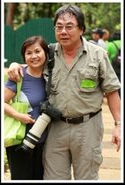
But today, Kathy and her little family are in Holland and John only spent the morning between the zoo to look after Maali, and FPPF to inspire young photographers. John made no plans to fly his RC planes today – I wonder why. John and I – just the two of us - had the rest of the day – from lunch to dinner – to saunter around the mall. John promised to avoid the usual restaurants, and we tried the Mu Noodle Bar (he liked the beef noodle soup). This is out of our usual strategy – John normally does not like trying out new restaurants, but it was fun. John even threw in a little malling, as we explored the new computer shops on Glorietta 2. Again, that was a special treat – not because of the shops – I didn’t buy anything, John did – but that it afforded us time together.

This is the icing on the cake:

CREATOR: gd-jpeg v1.0 (using IJG JPEG v80), quality = 95

Oh... Its Sunday... forget about everything... time to smell the roses... get a life... taking Harvey for a lunch date... Enjoy the day. FB Friends... Feels good speaking to a group of newbies at the FPPF Seminar...

John Chua One lovely lazy afternoon indeed... We went to check out Glorietta Two ( since we have been shooting the place last week... Ate at a MU noodle bar... got ourselves two powerful mini speakers for our laptops... window shopping... enjoying every minute... Now back home after the mass.... Hmmmm a nice home movie would be just perfect to end the day... I hope you got a nice day too... You deserve it... Tomorrow... well its another day.

Thursday, June 13, 2013

War Photographer


At the beginning of each term, as I face a new class, I always ask my students what specialization they wish to get into. Nowadays, it’s mostly fashion or travel, but I came upon a demure, slim, very feminine looking girl – probably 18 0r 19 years old – who very shyly said “war photography.” I wasn’t sure that I heard her right, so I asked again, and in almost a whisper, she repeated, “War photography. I would like to be a war correspondent.”

I was intrigued. I asked her why she had thought of becoming a war photographer. She said that as a child, she came upon some black-and-white war pictures and saw the strong emotions portrayed in them, and since then, she has been wanting to do the same kind of powerful imagery. She wanted her photographs to be memorable.

Since I did not want to pay singular attention to her, I moved on to ask the others, but I continued to be intrigued by her ambition, since it seemed inconsistent with her appearance and demeanor.

On our third session, we delved deeper into the different genres and the personal characteristics of the photographers pursuing each specialization – that someone who would like to do fashion photography would do well being fashionable herself, that a landscape photographer should be an early riser to catch the fleeting sunrise of a beautiful morning. That someone who wanted fixed hours should not do advertising photography, which we know demands work beyond normal hours, but probably should work in a portrait studio in a mall. As I went through each of my  students’ choices, I named a few very well known photographers who represented each genre.

When we touched on war photography, I named a famous Filipino photographer who had covered the war in Iraq and Afghanistan but somehow, in an effort to put across the message that war photography has its own intrinsic risks and extraordinary demands, I got drawn to cite John’s own experiences while covering coup détats. I related that I would be nervously praying for his safety every time he left the house for such assignments. At that time, the military was restive and John was doing photography for Asiaweek.

I asked her if her family would be able to accept the risks that she would face as a war photographer. She did not answer. Is she physically fit and mentally agile?  Would she be able to think on her feet to make split-second decisions that may be necessary to save her own life?

A scene flashed in my head – of a story that I heard from John, and for which I am eternally grateful that he survived and I did not have to witness. He was covering one of a few attempts to overthrow the Corazon Aquino administration. John said that he had aimed his camera at a soldier, a bit far from him but within the range of his telephoto lens, who was aiming his rifle at a civilian, when suddenly, he found the end of the soldier’s gun aimed at him. For a nanosecond, he froze, then realized that he had to disengage from this encounter. Understanding that the soldier must have been also tense at the moment, he did not want the soldier to further feel challenged, so without looking at him, and in the slowest manner, he turned his telephoto away from the soldier and downward to the ground. He pivoted his body to also turn away from him, took a well-planned step, again in the same slow-motion fashion that made a few seconds seem like eternity. Still curious as to how the soldier was reacting to him, he caught from the corner of his eye that the soldier also turned and walked away from where he stood. John withheld even a sigh of relief so as not to call further attention to his presence. During that tense moment, the last thing he wanted to hear was the sound of a gunshot, since silence meant that he was still alive.

After covering a few coup d états, John was starting to believe that he would make a good war correspondent.  He probably would have, but it would have come at the expense of my sanity. He told me that if he didn’t have a family, he would have gone. I am glad and grateful that he went back to being an advertising photographer. It’s not exactly an uneventful life – something that is hard to do with John - but at least we were far from a war photographer’s daily dose of life-or-death situations.

I hope my student listened to my narrative about John. It was not just a story -  it was my personal plea for her to reconsider her choice of a career in photography. But then, I know of course, that it is her decision and not mine. 


Sunday, May 26, 2013

Stars and Skype


A long distance relationship is difficult, but nowadays, technology makes it somewhat bearable. Cellphones and computers allow friends, families or lovers to chat and see each other at any time of day or night, and in the privacy of their own rooms, or even cars (Just don’t drive and text).  And while we need to pay for Internet or cellphone service, connecting to another anywhere in the globe is actually free with Facetime, Viber, Hangout or Skype.

In the early 1970’s, when John was courting me (in those days, men courted women and we never said  “when WE were courting …”), John’s mother did not approve of me because I was encouraging him to work as a photographer, which meant that he was not paying attention to the family business. To separate us, she sent him off to Iloilo to stay with his sister. Now, in those days, there was no Internet, email or Skype, there were no cellphones or even pagers, and public coin-operated phones were just for local calls. Mailed letters took a long time, so any messages that needed to be rushed were sent by telegrams. 

My family was poor and we did not have a phone at home. If John wanted to call me, he would have to call my aunt’s house, which was next door, and wait for someone, usually my aunt’s maid or houseboy (then called servants) to call me and for me to rush to my aunt’s house. With cousins practically eavesdropping, there was no chance for John and I to say sweet nothings to each other. Besides, in those days, telephones had party-lines, meaning, two phone owners, usually neighbors, took turns in using one phone line. As a matter of phone courtesy, when one lifts the handset and hears someone talking, that person must put the phone down gently, and wait. If you’re the one using the phone, sometimes, it meant hearing that handset being lifted and put down over and over again, and when the other party becomes impatient, they say “Hello, party line, puede ba ako naman (may I have my turn?)  There was no way to stay on the phone a long time to make “telebabad” (staying too long on the phone).  

It was too embarrassing to use my aunt’s phone to call long distance, so for calls that I would have to initiate, I would have to go to the Philippine Long Distance Company office in Port Area, near the foot of Jones Bridge (two jeepney rides or approximately five kilometers from Paranaque, where I lived).  There were booths there, and callers were guaranteed not only soundproofed privacy, but also no party lines waiting on the wing for me to finish my call. But long distance calls were expensive, and I did not have the money to make such calls. 

Before he left for Iloilo, and anticipating the difficulty of keeping in touch given that I did not have a phone at home, John agreed to my romantic suggestion to connect somehow by agreeing to gaze at the sky, and look for Orion’s Belt (a row of three stars) at the same time every night at exactly 7:00PM. We synchronized our watches. There no cellphones or Internet, it is true, but what we had was a direct connection, soul-to-soul through the stars, it was private, and it was free. Who needs Skype?

John eventually came back to Manila. We set up Adphoto, got married, and raised three daughters.Today, we connect with our children, relatives, friends and each other through Skype, Google Hangout, Viber, Facebook or FaceTime and marvel at how technology keep us connected;  but once in a while, through the more than 40 years since the 1970’s, when John and I look up at darker provincial skies (disappointingly, Metro Manila’s pollution and bright city lights obscure views of Orion’s Belt), we give thanks that when we did not have Internet or Skype in the 1970's, we had the stars in the sky to give us direct connections and clear signals.  We’re still together, so obviously the stars worked. 

Tuesday, April 16, 2013


Today, April 15, is the birth anniversary of my dear mother, Dolores Lombos Valentino, who died of ovarian cancer in 1978 at the age of 55.  May I ask you to join me in saying a prayer for her? I remember her very fondly - she was very hardworking (she ran a handicraft business with my dad), always very cheerful, and sacrificed a lot for us. I remember many hot summer nights as a child - before we could afford an electric fan - she would use an anahaw leaf fan to help us bear the heat and go to sleep. She was also a good dressmaker - and I would watch her sew my clothes using a Singer sewing machine (that I much later learned was bought with a loan from Harvey Jewell, the man after whom I was named).  I would watch and wait until she finished, because it was an excuse to stay up late.   Because we were poor, new dresses then were only for special occasions or when needed in school, so to watch a new dress being made was exciting.  Until I was in college, she was sewing clothes for me.

Oh, college! In my final year in college, I stayed in an apartment outside of the U.P. Diliman university campus with three American room-mates. One night, they had a party with some fraternity guys, and the apartment was a mess in the morning - the floor was littered with empty beer, scotch or gin bottles. That was the day, the only day,  when my mother came unannounced to bring me extra food - and although I didn't drink, I didn't know how to explain the mess to her. To my relief, she didn't ask.

I also remember that in 1966, she worried about my traveling to Baguio and Banaue with some friends. For some reason, she was always worried about my safety, but after the trip was done, and I was back home, I would hear her proudly tell others about my adventurous trips to places she herself had not seen.

One of the regrets of my life was not attending my university graduation ceremony. It was optional in 1969 when I earned my degree in political science,  and I was young and at that time, still rebelling against traditions and conventions. I was the only one among my siblings to finish college, and yet, I denied my parents that proud moment of seeing me march to receive my diploma. I am sorry, Nanay and Tatay, I wish I could turn back the clock to undo one of the biggest mistakes of my life.

Thank you for loving me, Nanay. I love you, too, and miss you very much. I wish you were still here to see my own daughters, and now, my apo. It would have been fun to celebrate your 90th birthday here, but celebrating in heaven is, I am sure, far better.  Happy birthday, Nanay. <3

Thursday, November 15, 2012

Meeting a former Adphoto photographer


While Kathy, John G and I were walking towards Mother Care at the Fort, we chanced upon a former Adphoto employee whom I had not seen since he left, about five years ago. I could not believe how he reacted to seeing me. He hugged me for a long time, and if I had not wriggled my way out of his tight embrace, he would not have let go, and when he did, he was in tears. I was deeply touched. Then he showed me pictures on his iPhone of his four-month old son. All I could say was, "Imagine that - you're now a father! To think that you were a kid when we took you in!" He was a student at La Salle, taking up computer science when he came to do OJT, and after the program, he refused to go back to school, and pleaded with us to hire him as an assistant. We did. When he was with us, he devoured all that John shared about photography. John never withholds when he teaches an apprentice, so this young man learned a lot. But the lessons that I tried to impart - on the business side, on marketing, on developing presentation and negotiation skills were lost on him - like many photographers, he was not interested. He stayed with us a few years, maturing as a photographer. He is now on his own, and I can imagine that whenever he faced business challenges, he probably heard my voice in his head. I suppose those lessons remained dormant while he was with us, like data that is inputted into a computer but simply ignored, but now that he is not only a photographer but also a business person, he discovers that it was there -has always been there - for him to retrieve. No lesson is really ever lost - when the right time comes, it will be used - this is what I love about teaching, and that was the affirmation that I received last night. :)