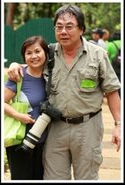
Wednesday, May 09, 2012


I am trying to get in the habit of writing, so here's something, not quite finished, and not quite edited... 

Photography: First Love

For John, his falling in love with photography came with thunder and lighting effects, so to speak. He was a high school graduate, and quite lacking in confidence that he could make a name for himself. One day, his sister’s husband, Ric, showed him a camera, and he “borrowed” it. The word “borrowed” is in quotation marks because he did not ask permission to use it. His curiosity got the better of him, and he took that little camera – a Canon QL17 rangefinder – loaded it with film and pointed it at everything he could see – plants in the garden, frogs and even cockroaches. He was thrilled! It was in the days of film, and in order to save on cost of films and processing, he limited himself to one roll of film. He challenged himself to produce at least one good picture from each roll of film.

Ric was excited that someone shared his interest in photography, and invited John to see his darkroom. Again, John was filled with wonder upon seeing images begin to appear on papers soaked in developers. With whatever savings he had, John began to build a darkroom under the stairs of his mother’s house, and went on to do black-and-white printing. He wanted to see his photos right away, and could not wait for photo shops to process and print his pictures, which in those days meant a wait of a few days.

He was showing off his pictures to anyone and everyone who cared to look at them. At that time, he had no concept of portfolios, so all he was carrying around were 5”x7” photos.

One of the people who appreciated his photos, and thought he had “an eye” for photography, was the general manager of a printing press whose client was the publisher of a small, low circulation travel magazine, “Manila This Month.” He took a few of those photos and showed them to the publisher. The publisher offered John P500.00 a month (just for comparison, the minimum wage then was P120.00 a month) for his photography – but that was to be inclusive of use of his equipment, films and processing, and prints;  plus all his travel expenses, as well as the salary of his assistant. Obviously, P500 a month was not enough to cover his “cost of doing business.”

This was in 1970, I was 24 and working with that magazine as a writer. Our first assignment together was to do an article on rattan furniture manufacturing. When I was advised that the photographer assigned to this project was waiting for me infront of the building, I went down. On the driveway, I saw a huge white American car – a Pontiac Parisienne, a young Chinese in his early 20’s, wearing white long-sleeved trubenized shirt with rolled up sleeves, black rimmed glasses, and hair stiff with pomade. An even younger assistant was carrying his black camera bag, while inside the car sat his (actually his mother’s) driver. I worked with other photographers before, but they usually came alone, so I was shocked to see a three-man party, and said to myself, “All who’s missing is his mother!”

During the long ride from Manila to Cavite where the factory was, I tried to engage him in conversation, but he was painfully shy and answered me in monosyllables or one-word answers, so after a while, I gave up trying.  At the factory, he went straight to work, and was quiet the whole time except for one-word instructions, “dito” (here), or “doon” (there) that he mumbled to his assistant. On the other hand, I was having an animated conversation with the owners of the factory, and sometimes with the workers, whom I also interviewed.

We were done by noon, but the owners would not let us go without getting us to accept an invitation to a seafood restaurant for which the town was known.  John sat with his assistant and driver at one end of the long table, and quietly and quickly finished lunch – I believe in two minutes flat – while I savored the food – oysters in vinegar and onions – and the conversation with our hosts that lasted about an hour. As he waited quietly and seemingly enraptured with his camera, John was simply oblivious to all of us.

In the next few months, I gave him a few more assignments to accompany my articles, sending him to photograph the University of Santo Tomas a few times, and handicraft products at S.C. Vizcarra’s. I also introduced him to my other photographer-friends.

After I quit my job at Manila This Month and in the next couple of years, we went from magazine to magazine, offering our partnership with me as writer and he as photographer. At a men’s fashion magazine that we briefly joined, I quit when my boss decided not to publish a story on a restaurant manager because the restaurant was not going to advertise in the magazine.  Besides, while my pay was okay, John was only being offered gift certificates for his photography and I did not think that was fair.

After a couple of years of partnering together, John and I talked about what we liked to do, and we agreed that we both liked travel and adventure. From that analysis, it was easy for us to decide that we would do travel articles. We boldly approached Sunday Times Magazine, and offered them a story on the Moriones Festival in Marinduque, since we were planning to go there with friends.  I asked how much they would pay for the story and photographs, and the editor said “P100.00.”  John and I discussed the offer and while we found it low, we rationalized that we were both inexperienced, and were willing to start at the bottom by accepting the low fee. However, when I asked further, “How much would you give for travel expenses?” I was both disappointed and aghast when I was told that P100.00 would cover all – payment for the article, photos and travel expenses. It was a rude awakening and we very quickly realized that we could not live on income from travel photography, at least not from local magazines.

At that time, John had a friend whose brother owned Trebel Industries, makers of pianos and inventors of the one-man-band (precursor of electronic pianos that can produce music as if from different instruments). They needed a photographer to photograph a young protégé named Cecille Licad. The company was then handled by an agency called Nation Ads. John got the assignment, and so, we got introduced to advertising.

Since advertising work was still quite irregular, John volunteered to assist a British Broadcasting film producer, Hugh Gibb, who was doing a 16mm documentary film on the Philippines.  In the course of this assignment, he and Mr. Gibb went all over – Manila, Cebu, Banaue and later on Mindanao. In the meantime, I decided to enroll as a special student in the College of Fine Arts and Advertising in UST, but stopped without finishing the semester because President Marcos had declared martial law.

John was in Marawi in Mindanao with Mr. Gibb when martial law was declared in September, 1972, and both hurried to fly back to Manila. Mr. Gibb returned to Hong Kong, unsure if he could finish his film on the Philippines.

The young art director at Nation Ads, Veyong Rollamas, introduced us to other advertisers– Motolite Batteries and Apex Motors. Even though there was political turmoil and the economy was down, there were photo assignments streaming regularly from this advertising agency.  We decided to establish our own studio and to rent a place where we could hold office and build a darkroom. The ad agency offered us the space (bodega) where they kept all their old newspapers and magazines, but the next day, the offer was withdrawn as the owner’s husband said he would use the space for his law office.

I felt bad – being edged out like that, so I got a copy of the Manila Bulletin to look for office-for-rent ads.  Although John was picky about where to set up our studio  (No to certain areas of the city, and no to certain streets), he did not have the patience to inspect places. I had to do this all by myself. Then when I found a place that I liked, he came along. After a few days of searching, and inspecting different office spaces,  I found one – Room 306 Rufino Antonio Building on 60 Buendia Avenue, Makati. This was our first studio. The landlord, represented by his young daughter – younger than John and myself,  gave us a generous offer. The monthly rental of P215.00 included free electricity and water, and while we were moving in, the landlord’s carpenter, electrician and plumber would serve us for free. All we had to do was buy materials (1/4 plywood was P4.00 each, while ¾ plywood was P25.00). Aside from putting up partitions so we could have a darkroom, the carpenter also built our cyclorama.

We had earned P1,000.00 from supplying the Nayong Pilipino Ethnographic Museum with black-and-white prints of John’s shots of Ifugaos and Maranaos, and subcontracting the printing of photographs done by Dr. Robert Fox, and we used this money to pay the deposit and first month’s rent, and buy construction materials.

As soon as the darkroom was built, and the enlarger was installed, we had our first printing order – from another advertising agency.

To be continued…
I am trying to write every Wednesday, so this is going to be one long blog in several installments. Hopefully, I will be able to write the installments. I heard a speaker, Sarah Kay, say - that to accomplish what I need or want to accomplish, I should say three short sentences. "I can." "I will." "Begin."

So here goes...


Photography: First Love

For John, his falling in love with photography came with thunder and lighting effects, so to speak. He was a high school graduate, and quite lacking in confidence that he could make a name for himself. One day, his sister’s husband, Ric, showed him a camera, and he “borrowed” it. The word “borrowed” is in quotation marks because he did not ask permission to use it. His curiosity got the better of him, and he took that little camera – a Canon QL17 rangefinder – loaded it with film and pointed it at everything he could see – plants in the garden, frogs and even cockroaches. He was thrilled! It was in the days of film, and in order to save on cost of films and processing, he limited himself to one roll of film. He challenged himself to produce at least one good picture from each roll of film.

Ric was excited that someone shared his interest in photography, and invited John to see his darkroom. Again, John was filled with wonder upon seeing images begin to appear on papers soaked in developers. With whatever savings he had, John began to build a darkroom under the stairs of his mother’s house, and went on to do black-and-white printing. He wanted to see his photos right away, and could not wait for photo shops to process and print his pictures, which in those days meant a wait of a few days.

He was showing off his pictures to anyone and everyone who cared to look at them. At that time, he had no concept of portfolios, so all he was carrying around were 5”x7” photos.

One of the people who appreciated his photos, and thought he had “an eye” for photography, was the general manager of a printing press whose client was the publisher of a small, low circulation travel magazine, “Manila This Month.” He took a few of those photos and showed them to the publisher. The publisher offered John P500.00 a month (just for comparison, the minimum wage then was P120.00 a month) for his photography – but that was to be inclusive of use of his equipment, films and processing, and prints;  plus all his travel expenses, as well as the salary of his assistant. Obviously, P500 a month was not enough to cover his “cost of doing business.”

This was in 1970, I was 24 and working with that magazine as a writer. Our first assignment together was to do an article on rattan furniture manufacturing. When I was advised that the photographer assigned to this project was waiting for me infront of the building, I went down. On the driveway, I saw a huge white American car – a Pontiac Parisienne, a young Chinese in his early 20’s, wearing white long-sleeved trubenized shirt with rolled up sleeves, black rimmed glasses, and hair stiff with pomade. An even younger assistant was carrying his black camera bag, while inside the car sat his (actually his mother’s) driver. I worked with other photographers before, but they usually came alone, so I was shocked to see a three-man party, and said to myself, “All that's missing is his mother!”

During the long ride from Manila to Cavite where the factory was, I tried to engage him in conversation, but he was painfully shy and answered me in monosyllables or one-word answers, so after a while, I gave up trying.  At the factory, he went straight to work, and was quiet the whole time except for one-word instructions, “dito” (here), or “doon” (there) that he mumbled to his assistant. On the other hand, I was having an animated conversation with the owners of the factory, and sometimes with the workers, whom I also interviewed.

We were done by noon, but the owners would not let us go without getting us to accept an invitation to a seafood restaurant for which the town was known.  John sat with his assistant and driver at one end of the long table, and quietly and quickly finished lunch – I believe in two minutes flat – while I savored the food – oysters in vinegar and onions – and the conversation with our hosts that lasted about an hour. As he waited quietly and seemingly enraptured with his camera, John was simply oblivious to all of us.

In the next few months, I gave him a few more assignments to accompany my articles, sending him to photograph the University of Santo Tomas a few times, and handicraft products at S.C. Vizcarra’s. I also introduced him to my other photographer-friends.

After I quit my job at Manila This Month and in the next couple of years, we went from magazine to magazine, offering our partnership with me as writer and he as photographer. At a men’s fashion magazine that we briefly joined, I quit when my boss decided not to publish a story on a restaurant manager because the restaurant was not going to advertise in the magazine.  Besides, while my pay was okay, John was only being offered gift certificates for his photography and I did not think that was fair.

After a couple of years of partnering together, John and I talked about what we liked to do, and we agreed that we both liked travel and adventure. From that analysis, it was easy for us to decide that we would do travel articles. We boldly approached Sunday Times Magazine, and offered them a story on the Moriones Festival in Marinduque, since we were planning to go there with friends.  I asked how much they would pay for the story and photographs, and the editor said “P100.00.”  John and I discussed the offer and while we found it low, we rationalized that we were both inexperienced, and were willing to start at the bottom by accepting the low fee. However, when I asked further, “How much would you give for travel expenses?” I was both disappointed and aghast when I was told that P100.00 would cover all – payment for the article, photos and travel expenses. It was a rude awakening and we very quickly realized that we could not live on income from travel photography, at least not from local magazines.

At that time, John had a friend whose brother owned Trebel Industries, makers of pianos and inventors of the one-man-band (precursor of electronic pianos that can produce music as if from different instruments). They needed a photographer to photograph a young protégé named Cecille Licad. The company was then handled by an agency called Nation Ads. John got the assignment, and so, we got introduced to advertising.

Since advertising work was still quite irregular, John volunteered to assist a British Broadcasting film producer, Hugh Gibb, who was doing a 16mm documentary film on the Philippines.  In the course of this assignment, he and Mr. Gibb went all over – Manila, Cebu, Banaue and later on Mindanao. In the meantime, I decided to enroll as a special student in the College of Fine Arts and Advertising in UST, but stopped without finishing the semester because President Marcos had declared martial law.

John was in Marawi in Mindanao with Mr. Gibb when martial law was declared in September, 1972, and both hurried to fly back to Manila. Mr. Gibb returned to Hong Kong, unsure if he could finish his film on the Philippines.

The young art director at Nation Ads, Veyong Rollamas, introduced us to other advertisers– Motolite Batteries and Apex Motors. Even though there was political turmoil and the economy was down, there were photo assignments streaming regularly from this advertising agency.  We decided to establish our own studio and to rent a place where we could hold office and build a darkroom. The ad agency offered us the space (bodega) where they kept all their old newspapers and magazines, but the next day, the offer was withdrawn as the owner’s husband said he would use the space for his law office.

I felt bad – being edged out like that, so I got a copy of the Manila Bulletin to look for office-for-rent ads.  Although John was picky about where to set up our studio  (No to certain areas of the city, and no to certain streets), he did not have the patience to inspect places. I had to do this all by myself. Then when I found a place that I liked, he came along. After a few days of searching, and inspecting different office spaces,  I found one – Room 306 Rufino Antonio Building on 60 Buendia Avenue, Makati. This was our first studio. The landlord, represented by his young daughter – younger than John and myself,  gave us a generous offer. The monthly rental of P215.00 included free electricity and water, and while we were moving in, the landlord’s carpenter, electrician and plumber would serve us for free. All we had to do was buy materials (1/4 plywood was P4.00 each, while ¾ plywood was P25.00). Aside from putting up partitions so we could have a darkroom, the carpenter also built our cyclorama.

We had earned P1,000.00 from supplying the Nayong Pilipino Ethnographic Museum with black-and-white prints of John’s shots of Ifugaos and Maranaos, and subcontracting the printing of photographs done by Dr. Robert Fox, and we used this money to pay the deposit and first month’s rent, and buy construction materials.

As soon as the darkroom was built, and the enlarger was installed, we had our first printing order – from another advertising agency.

To be continued…

Monday, February 13, 2012

Two Hospitals. Two Different Experiences


A few hours after Kathy was born at Makati Medical Center, a fire broke out at the next-door building.  I was at the hospital wing closest to the burning building, and seeing the red orange flames being reflected on the walls made me really worried about my and my baby’s safety. With the intravenous tube strapped to my arm, and the doctors’ orders not for me to stand up yet, I could not help but feel helpless. My baby, born prematurely at 8 months, was in the nursery, even more helpless with IV needles and cables from monitoring machines stuck on her tiny head and arm. I called the nursery and the nurse in charge assured me that all the babies were safe.  However, that was not reassuring enough for me and I could only think of calling John, if not to rescue us, then at least to assess the situation. It was the middle of the night, actually early morning, when I suddenly arouse John from sleep. There is a Tagalog word “naalimpungatan” for this state of not being quite awake, and of not being rational because sleep was rudely interrupted and that was John’s condition as I pleaded with him on the phone to come. He argued – “But I can’t sleep there,”  “I don’t like hospitals” and I don’t remember what else, but there must have been fear in my voice, and caring in his heart that goes deeper than being “naalimpungatan,” and he came.

He looked out the window, saw the big flames and decided to wheel me out of the room. He saw that the hospital staff was doing the same thing to the other patients. As he pushed my bed along the now crowded corridor, he asked the man next to him, while pointing to the hospital bed that the man was pushing– “Do you have a license to drive that car?” Even in emergency situations such as this, John’s sense of humor floats to the top. The tension in the other man’s face eased and he smiled at John. We were taken to the far end of the hospital, where we waited for the fire to be put out. Before morning came, we were returned to our rooms, with the assurance that everything was back to normal.

Fast-forward 32 years later. I was under tremendous stress because of a vehicular accident involving our car and driver (I wasn’t in the car when it happened). Since John was out of town on one of his advocacies, I had to attend to the problem. When he came home a week later, he heard that my blood pressure had shot up and insisted that I checked into a hospital where my medical condition could be monitored.

He attended to all the details of my confinement, calling our favorite doctor (Dr. Antonio Oposa, who is actually a surgeon) to arrange my hospital stay. He also brought in dinner from outside – I’m not too enthusiastic about hospital food – and ate with me. Expecting many boring hours, he brought his computer and his Wi-fi, and when he was done with posting on Facebook, and assessing the bedding situation – one pillow each, a blanket from home for me, and nothing else to put on the narrow and short couch, he turned to assure me that he loved me and that he was spending the night with me at the hospital.  Wow, that is certainly new, I felt really touched not only by his declaration of love for me – which comes fairly often especially now that the children are all grown up – but more so by his presence at the hospital.

Although John could talk about photography or his advocacy for hours, he is also known for taking under of two minutes to finish dinner, and spending no time at all for after dinner conversations. But tonight, we chatted for a long while, telling stories of recent events, as well as assessing our lives.  We laughed as we asked each other if this is how being old changes us. He tucked me in, combed my hair with his fingers, kissed my forehead, and ordered me to rest. Then, with nary a complaint, he laid down on the narrow couch, with his street clothes (his trademark Columbia outfit) still on, to sleep in the hospital with me.  I felt loved.

Thursday, June 30, 2011

When in Rome...


During a recent trip to Rome, John and I stayed at a bed-and-breakfast place run by Catholic nuns. It was towards the end of May, and officially not yet summer, but it was warm. We saw a wall-type air conditioner mounted near the ceiling and therefore out of reach, but the remote control was nowhere to be found.  Our room was on the third floor of the building facing the street, which happened to be a main avenue. If we opened the windows to let the breeze in, we would also be letting in the roars from the Vespas and Ducatis - those famous Italian scooters that fill Italian streets, and there was no way that we would be able to sleep.

I considered going down to the first floor lobby to ask for the remote control, or at least to let the nuns know that we found the room warm. However, I balked at the idea since I did not (do not) speak any Italian.  Earlier when we were checking in, I discovered that the nuns manning the reception did not speak any English. To my disappointment, one whom I thought was Filipina turned out to be from Madagascar and did not speak any English either.

But it was warm! So I checked the little book “Italian for Travellers” that my nun-friend in a nearby convent lent me for the phrases “air conditioner” and “remote control” but no matter how many times I scanned the pages, the book contained no such words.  There was only the word “caldo” for “hot,” and the word “molto” (“very”), attached to another adjective, that I could put together.

A picture is worth a thousand words, we are told, and so I took a photo of the air conditioner in the room and went down with my camera. I remarked,  “It’s molto caldo in our room.”  In a very stern, but low, voice that reminded me of the nuns in my grade school, she admonished, “No fumare.” I understood that to mean “No smoking,” or “Don’t smoke.” To assure her that John and I were not smoking in our room, I nodded my head and echoed what she said, “No fumare.”  Since that did not lead me anywhere, I showed her the image on my camera’s LCD, and asked for the remote control, while I repeated my well-mastered phrase, “molto caldo.” She raised her forefinger and repeated “No fumare” and in quick Italian must have said something about the consequences of smoking (guessing from all the conjugations of the verb “fumare” that I heard her say). I tried to get my message across by fanning myself with my hand and repeating “molto caldo,” and “caldo molto” (just in case, in Italian, the adverb should come after the adjective).  It was funny because all sorts of Spanish words- courtesy of Spanish language lessons during college days - were coming to my head in my attempt to explain that it was very warm in our room.  I was frustrated and starting to fret, while she remained firm and stern. To add to my frustration that I could not get myself understood, I heard her very matter-of-factly warn me, while pointing to the smoke alarm and vigorously twirling her forefinger,  “Fumare – wang, wang wang.”  She said something else but all I could understand was “dormir.“ With a simple wave of her hand, while maintaining eye contact, she said softly but with finality, “Buona notte!” I guessed that what she was saying was “Go to sleep, good night,” and that was it – end of discussion. It was frustrating – not only to be unable to communicate but to be made to feel like a grade school pupil in a Catholic school. At 65, I did not think a nun could still make me feel that way. J

Resigned to sleeping in a warm room, I went back upstairs. After an hour or so, I saw that the brochure that I picked up at the front desk earlier contained the phrase “aira condizionata” which I took to mean “air conditioned.” “Aha,” I said to John, "here’s what I can show her." I also wished (maybe prayed is the more correct word) that the nun whom I encountered earlier would no longer be on duty.  I walked down the stairs to the ground floor. She was there with another nun – not the smiling nun from Madagascar but someone who looked like the Italian Mother Superior. Hope springs eternal, and I pointed at the brochure and said to them “molto caldo aira condizionata . ” That was the full extent of my Italian in one go.  That hope was doused quickly when the older nun said simply, “no funzione,” and all I could do was meekly repeat, “aria condizionata, no funzione.”

I had no choice but to accept defeat. Bowing slightly to the two nuns before me, I whispered, “Buona notte,” and headed back to our molto caldo room. 

Tuesday, June 28, 2011

Motorbike Backrider


Carless and often cashless, our only means of transportation in the 1970’s was John’s 350cc Honda motorcycle, a gift from his father. It was a cozy way to be riding together, with my arms around him for safety.

Riding the motorcycle was the way we picked up and delivered work. During those days, there were no personal computers (no “Powerpoint” or “Keynote”), and slides for audiovisual presentations were made from photographing handmade artworks drawn on 30”x40” illustration boards. If available, words were made with the use of letter transfers (“Letrasets”) and if not, they were created by skillfully airbrushing them on the boards. The boards are carefully wrapped because the colored inks used on them were attractive to roaches.

Since all we had was a 35mm Nikkormat with a 43-86mm zoom lens, most of our jobs were doing these slides. We would pick up the boards from the ad agency and bring them to our studio to shoot.

John would get up on his motorcycle and I would then gingerly mount the motorbike behind him with the wrapped illustration boards between us, leaving me with no way to wrap my arms around John or to hold on to any part of his big bike.  As long as we were not riding over speed bumps or potholes, we were fine, but John would continue to show his concern for me by saying, “Talk to me and keep talking, so I’ll know that you’re still there.”

Wasn’t that sweet? ;)

Friday, June 17, 2011

John in Adobo Magazine


Here's a very straightforward article by Adobo Magazine's writer, Mia Marci on John and his passions - photography, especially aerial photography; flying; his pet elephant, Maali; his advocacy, Photography with a Difference, that works with special children and persons with disabilities; getting a street in Manila, R. Hidalgo, to become a photographers' haven.  John's photo was taken by our daughter, Kathy.

Tuesday, February 01, 2011

John's Talk: Photography with a Difference - Touching Lives Through Photography

January 31, 2011

Today, John faced a tough challenge – how to make his topic, "Photography with a Difference – Touching Lives Through Photography” interesting enough to get delegates out of bed for a very early morning (8:30am) talk.  Participants in this year's Photoworld Asia Convention came from all over the Philippines and some Asian countries and as far as Qatar, and paid to learn photo and digital imaging techniques. But there was John, getting ready to get them to do photography that John himself says requires no skill, and no special equipment.

This is not the first time for John to be invited by the organizers of this annual event, but normally, they put him in the first slot after lunch. Unlike most speakers who represent a specific expertise or style, John has been called a serial specialist. He is as adept inside the studio shooting food, products or cars, as he is outside, doing aerial photography or photographing buildings, interiors and industrial sites.  He shares whatever he knows, and after almost 40 years in his profession, his reservoir of tips and techniques that he readily shares with fellow photographers is very deep. More importantly, they know that his honest and irreverent sense of humor, his booming voice, and many tricks up his sleeve would wake up his audience any time.

He brought, for example, a few bags of Super Lemons, and had them distributed to everyone in the audience, with the instructions that they may pop the candy into their mouths only when he gives the signal.  But wait - maybe I should not tell you about this trick, in case you have never listened to John give a talk.

He also brought a lot of goodies, and thankfully, Canon is one of the sponsors. John has been named a “Canon Ambassador,” together with a select group of professional photographers, so yesterday, John approached their marketing department for corporate premium items to give away. He was like Santa Claus today, giving out Canon books, luggage tags, coffee mugs, folding canvas stools and magazines – to early bird attendees, those who asked questions, and at the end of his talk, when he still had leftover gifts, to anyone who happened to be within arm’s reach.

John is very passionate about the topic assigned to him. To ensure that his audience would be enticed to learn about Photography with a Difference, he gave an unsolicited and un-scheduled mini-presentation, and posted a few photos on the wall during the first days of the conference. And even though he had prepared his talk and audiovisual presentation several days before today, he spent the whole night perfecting his presentation, providing more “success stories.”

To establish credibility with those who were going to listen to him for the first time, he started by very briefly introducing our company and presenting our portfolio. Then, he narrated how “Photography with a Difference” as an advocacy was born, after which, one by one, he showed pictures from more than 25 workshops and photo exhibits that have been done so far.  He told the stories of how many workshops were started without any funds, and how they were built on the strength of dreams. He spoke of not having any organization, and on running this entire advocacy on Facebook. He shared the story of his “magic notebook,” where he wrote his wish lists, and dream projects. He reminisced about his meeting with the advocacy partners or sponsors - SM Malls and Canon Philippines. That they had no memorandum of agreement, no written proposals, no contracts – just shaking hands to seal their agreement and resolve to continue with this advocacy. Already running late, he ended his presentation by playing a touching video by Joel H. Garcia, one of the regular volunteers of Photography with a Difference.  In that short but heart-tugging video were pictures of visually impaired children who were having the time of their life exploring the zoo, and bonding with their parents and their photographer-partners.

There was no more time for questions, so he invited them to follow this advocacy on his Facebook, or to email him. At this point, we could not gauge how well John had succeeded in arousing his audience’s interest in this advocacy, until the audience stood up to give John a standing ovation!

To give way to the next speaker who had been patiently waiting for his turn to speak, we quickly gathered our materials and moved to the side of the room. Not a few photographers rushed to John to ask him to sign their books, flyers, photos, notebooks, papers – anything they could get where John could sign. Then they followed him still when John left the room, to ask how they could join, or how they could lead such advocacy projects. Two of them were Filipinos living in New Zealand, a couple of Filipinas from the U.S., a Filipino who lives in Guam, and a recently retired military man who himself has a special child. Others were members of local camera clubs. We exchanged business cards, as we promised to send them more information on how they can participate in reaching out to persons with disabilities through the “Photography with a Difference” advocacy.

Like a tireless evangelist, John has planted the seed of his advocacy once again. We will wait to see where the seed will grow, and hope it spreads to other parts of the world.

Sunday, January 30, 2011

Good-bye, Tatay Harvey

Today, I say goodbye to my namesake and my late parents' dear friend, Ret. Lt. Cmdr. Harvey E. Jewell, who bade us all a final farewell on Wednesday, January 26, 2011 in Kingsport, Tennessee. He crossed over to his glorious next life while surrounded by his family – children, son-in-law, and grandchildren. He was 87.


I will miss him terribly, but would like to thank God for letting me find him on the Internet in December 2007, which led to my getting to personally meet him and his family in July 2008 in Kingsport, and again in October 2010, when we honored him at a gathering of family, relatives and friends in West Orange, New Jersey.

Dear Tatay Harvey, now that I've met your family, and my family has met yours, we hope to continue the friendship that you and my parents began in 1946. 

Goodbye, Tatay Harvey. I love you. As you journey into the next life, please give my love to my parents, whom I also miss very much. 

"Bless them, O Lord, and let perpetual light shine upon them (Harvey E. Jewell, Ruperto S. Valentino, Dolores Lombos Valentino). May they rest in peace. Amen. "

Monday, January 24, 2011

The Little Boy Who Likes Zip Lines


Ever since newspapers picked up the story about John teaching Ian, a young man with autism, how to express himself through photography, parents of similarly situated children have been bringing their little boys and girls to him. Some of these children are probably too young to learn photography, so John ends up inviting them to come to Manila Zoo to meet Maali, the elephant that John has been taking care of for the past ten years. Within the main zoo, there is also a wonderful place called Kinder Zoo, where they can touch and be photographed with animals. Recently, it has set up a rock wall, and a zip line for children.

I remember John's story about one such little boy with autism. His name was Carlo. He did not like Maali, so John looked around for something to interest him. He was not keen about snakes and baby crocodiles at the Kinder Zoo, or its tortoises and monkeys. But he got attracted to the zip line, and pointed it to John. That’s what he found interesting, and that’s what he wanted to do.

John has learned that children with autism have no sense of danger, so John did not know if he would hold on to the rope until he was safely at the end of the zip line. He was very young, maybe 6 or 7 years old, and the mother could not reassure John either, as this was this boy’s first time for this kind of adventure.


John decided that to be sure this boy was safe on the zip line, John had to be holding on to him.  The zip line was low because it was designed for little children, and John could be on the ground, running the full length of the zip line. That would have been the best arrangement.  The line is about 50 meters long- a half of a hundred meter dash, and John thought that was doable. John was game, and so was Carlo. There was no need for anyone to push them from the platform. John simply had to run along with this little boy perched on a round seat that was hanging with a rope from the zip line. Off they went, and John zipped along on the zip line.  Just as they came to the end of the line and John, huffing and puffing, was feeling grateful that he/they made it, this boy gleefully said “Again!”. Without hesitation or asking for a break, John said, “Of course,” and ran again. He huffed and puffed again, but he felt good to have satisfied this little boy’s whim to try the zip line. Twice.

He came home tired but happy to tell me the story of the little boy who likes zip lines. :)

Sunday, January 02, 2011

Adventures and Misadventures


There was a time when John wanted to learn how to fly hang gliders. There was no way to stop him. I knew that the more I tried to stop him, the more he would insist on doing it. So I kept quiet, and prayed. Then one morning, he came back early - meaning he did not go hang gliding even though he left for that purpose.

He told me that he was too early for hang gliding and when he arrived at his instructor's place, the guy was still cleaning his kite. The guy was in shorts, and all his scars were visible. He told John about the different scars on his legs and body and what caused them - all from hang gliding accidents. John decided that he did not want to learn hang gliding anymore. :)

Another time, John wanted to go sky jumping. (What’s with this man?) He took all of us, our three daughters and myself, to Tanauan, Batangas, where his friend’s son was teaching it. He already knew I would not do it, but he was able to convince at least two daughters to try it with him.

I’m timid when it comes to adventures, but I made great effort, especially when my children were very young, not to show or transfer my fears, or my lack of courage, to them. I did not want them to be fainthearted like me. I wanted them to have as much fun as their dad was. Although scared, I said yes to the scariest rollercoaster rides, was John’s first passenger on an ultralight, went up to the sky in a glider (not hang, but a real one), was first to hop on cable cars, went scuba diving, spelunking, approached and touched all sorts of strange animals – whatever adventures we faced. I just kept quiet and prayed for our safety, and said my silent “thank you’s” when my feet touched the ground again.

That morning, my children were older and I felt I did not have to show any more false bravado. John greets his pilot-friend, Mannie Baradas, who in turn introduces us to his son who teaches sky jumping. But this young man was in a wheelchair! “My God,” I was screaming silently in my head. He must have seen my reaction to the sight of him, and so he reassured me that he was not teaching today. He had a “little” accident while skydiving, he said, so his other instructor, would take over giving lessons that day. “Oh, thank God,” I said again in my head, “maybe there’s somebody else who has better judgment, or better timing, or whatever it is that you need to avoid breaking your bones while sky-jumping.”

Mannie’s son called the other instructor to come out, and he was in crutches!!! At that point, even John did not think it was a good idea to try sky jumping. I did not have to make excuses for not signing up for lessons, John and the girls took care of that. I think that day we decided to go sailing in nearby Talisay, but when we think of adventures and misadventures, we still talk about our close encounter with sky jumping that day.

Wednesday, December 22, 2010

Grown Up or Children's Talk


As a young mother working at home with my husband, John, to build up our photography business, I often felt harassed by my three young children fighting over toys or other domestic issues while I was on the phone with my client. I felt embarrassed because I was in an "unprofessional environment," since I was sure that my client could hear my children screaming and crying in the background. I may not have been as patient with my children as I should have been, but I remember explaining to them that if they were fighting over toys, then they would take their fight to other room and not where I was on the phone - they had to keep quiet because I was on the phone with a client, but if someone among them was hurt, then I don't care if I were talking to a CEO, I would put the phone down immediately to attend to them. Satisfied that I had given my children a good explanation on why they should be quiet, my children asked, "Mom, what's a client? What's a C.E.O?" :)

Sunday, December 19, 2010

Discovering Family Trivia

Since the party honoring Ret. Lt. Cmdr. Harvey E. Jewell, the man after whom I was named, did not afford us quiet time for conversation, we decided to invite Harvey, his daughter Sylvia and son-in-law Gary to lunch. And of course, our NJ hostess - my mother's first cousin and my dear friend, Myra.  Another dear friend, Ann Gay, was taking her flight to return to Boston later that day so we decided to meet halfway between West Orange where we were staying and Clinton where Harvey's grandson lives. That half -way point was Morristown. Kathy and John G, who had spent the night in NYC had to return to West Orange in order to join us. Ching and her John flew out of NY to go back to Singapore while my John, Sacha and Wayne went to the city to take pictures so they could not join us.

It was a Sunday and Morristown was quiet. A restaurant that Myra called was not going to open until four in the afternoon. The only restaurant that was open within walking distance from where we parked was a Persian restaurant. We decided to be adventurous. Besides, John G. goes to Iran often for work and is familiar with Iranian food.

We were eight - Gary, Sylvia, Myra, Ann Gay, John G., Kathy, Harvey J and myself. Although there was nobody else in the restaurant at that moment, we still insisted on a quiet corner. As we pored over the items on the menu, John G greeted the waitress and the proprietor in Iranian which pleased them very visibly.

The conversation centered on Harvey (not me, the other Harvey) and his days in the Philippines during World War II. I brought out my red notebook so I could take down notes. He has a throat condition that makes it difficult for him to speak, or sometimes, to be understood. He asked me for my notebook and wrote "'Ship Salvage Fire-fighting and Rescue unit" and then a short while later wrote "Rudy operated the electric power system for the entire complex. He had three Philippino helpers."      

Curious, I asked him who Rudy was, and he said, "your dad." "My dad?", I asked wondering if Harvey made a mistake.  My father's name was Ruperto and all my life I've always heard him referred to by his nickname, "Piting", but I suddenly realized that Harvey and probably his colleagues in the navy had given him a nickname after Rudolph Valentino, the famous Hollywood actor. http://en.wikipedia.org/wiki/Rudolph_Valentino.  After all, that's my father's surname - Valentino. I was thrilled to learn this tidbit about my father. My father, Rudy Valentino.

Friday, August 13, 2010

Not on Friday the 13th: A Baby I Planned and Prayed For


When my second daughter was less than two years old, I had a longing for another baby. With the difficulty of two placenta previas and two Caesarean operations still fresh in my mind, I could have sworn that the maternal urge was more hormonal than emotional.  But it was very strong.

Since John and I already had two daughters, I consulted my OB-Gyne doctor for tips on how to have a baby boy. She advised me to take my temperature before rising from bed every morning, and to try to do “it” when my temperature rose (which meant that I was ovulating).

My in-laws, who are Chinese, suggested consulting the Chinese calendar. Computing from when I was born, I could find out which months of conception would produce a boy, and which months to avoid conceiving – if I did not want to have a third daughter. Unfortunately, nobody could produce that precious calendar.

Even with the well-scheduled “encounters,” I was not conceiving. After more than year of attempting to get pregnant at the right time of the month, I gave up. It was not fun sticking a thermometer into my mouth every morning, and pulling my workaholic husband from work so we could do “it.”

After coming up “negative” every month for over twelve months, I decided to stop trying hard, and declared that if God could will me to be pregnant, then He could will me to have a son. I left the business of getting pregnant entirely to God, and of course, to John. ;)

Then, in November 1982, I became pregnant! Alleluia!! I was so excited that even before my tummy started to bulge, I started wearing maternity dresses. When people who did not know John or our two daughters, Ching Ching and Kathy (then known as Ann Kay), would ask if I were on my first pregnancy. I would very proudly and confidently say that it was my third pregnancy, but my first boy. To those who knew us, I declared with as much confidence that I was going to have my first son.

I did resist the cliché to prepare baby’s things and clothes in blue. I was not going to typecast my children. I was going to teach my girls not to fear math, computers or mountain climbing, and I imagined myself teaching my son, as well his sisters, how to cook and bake, how to paint and draw.

My baby was due to be born on August 13, but I did not want my son to be teased about being born or celebrating his birthday on Friday, the 13th (like today). Instead, I asked my doctor if it was all right if she delivered my baby on August 12. She said yes.

I also resisted my doctor’s offer for me to undergo ultrasound tests. I innocently thought that I could will my baby to be a boy simply by declaring it to be so.
Many decades ago, when I was born, there was no such thing as an “ultrasound.” Parents, relatives and friends had to wait until the moment of birth to find out the gender of the newborn – so birth was a much-anticipated event, not only to welcome the new addition to the family, but also to find out if it’s a boy or a girl.

My third Caesarean was scheduled at the Medical Center Manila (MCM). I had an unpleasant experience at the Makati Medical Center where my two daughters were born, and I decided to change hospitals and change doctors. My obstetrician was the sister-in-law of a very close friend, and we often swapped stories about daughters – she has three of her own, and no sons.

Everywhere I went, I kept proclaiming that I was going to give birth to a baby boy. That is, until the hospital orderly was wheeling me into the operating room (Caesarean births are done in the operating, not delivery, rooms). Suddenly, I was filled with anxiety and apprehension about having a son. What if he became disobedient or disorderly, or rough and uncontrollable? I had remembrances of my brothers being scolded for not coming home on time, or being spanked for their mischief, while my sister and I were always conscious of obeying our parents. What if he became a juvenile delinquent, what if he became a drug addict, what if he grew up too short or too frail and his classmates would bully him, what if…

Then at that moment of great doubt, I prayed. I whispered to God to forgive my arrogant and foolish declarations about having a son. Please let me have another daughter. Please, Lord, please.

I was still praying when they gave me a sedative. I had insisted on being awake, so I was given only regional anesthesia. As the sedative kicked in and the anesthesia that was meant to deaden my body from my feet to my chest somehow seeped into my brain, I just surrendered to God and to the doctor whom I trusted with my life. But just before I went into semi-consciousness, I hastened to remind her of my request to please remove my keloids at my previous CS scar, and oh, could she also remove some of my belly fat?  But I am digressing. ;)

Half awake and half in limbo, I heard my doctor declare, “Harvey, you have a baby girl.” I was filled with excitement and became fully awake. She showed me my beautiful baby, and I was happy and grateful (for my baby and the additional procedures). I thanked her, and I thanked God for listening to me.

We named our third and last daughter, Sacha. She was born on August 12, 1983.

Happy birthday, Sacha – today should have been your birthday. 

Sunday, May 16, 2010

Car Photography: A letter to Randolph de Leon


Randy is a partially-blind photographer-hobbyist with a passion for cars. We met him at a workshop for the visually impaired that John conducted for his advocacy - "Photography with a Difference (PWD) - Touching Lives Through Photography." We learned that Randy loves cars, and if not for his impairment, would have wanted to be a race driver. Just for his own enjoyment, Randy shoots cars, especially during car shows. We invited him to our studio the other day during a shoot for Mitsubishi.

16 May 2010

Dear Randy,

I’m glad that you enjoyed your visit with us, and saw how car photography for advertising is done. Your own experience in shooting cars – in a photojournalistic style as you mentioned – is a good introduction but is not quite the same as doing photography for advertising, especially studio car photography. Our lighting has to be more studied, so I hope you did not get find our pacing too slow.

I suppose the two main differences between how you shoot cars and how we shoot is in how cars are lit and what angle or perspective they are taken.

Whereas, as you said, you depend on available light (or lights), we carefully decide each light or each reflection of a light that touches the car. 

Taking on a photo-journalistic style of car photography, you can afford to choose the angles or perspectives that look good to you, given the lighting condition present at where the car is, whereas our angle is dictated by the client or the art director (AD) in order to meet some advertising and marketing objectives.  This is why we cannot even begin to arrange lights until we have set up the car (or part of the car) according to the layout required by the AD. We cannot deviate from that perspective because it is that side or part of the car that they want to "sell." So we can say that you have more freedom in choosing your angle or perspective, since you shoot for your own pleasure while we, on the other hand, enjoy the exacting challenges of specific objectives.

Car photography for print advertising is so precise that it has developed its own jargon. We indicate how we will set up the car by measuring the proportion of the bumper (from the left to the right side of the front or rear of a car, in relation to the length of the vehicle – 1:2, 1:2.5, 1:3 etc.), we indicate the angle – front perspective, rear perspective, full frontal, full rear, perfect profile – the last three also being referred to as dead front, dead rear or dead side; we have to define the camera position - worm’s eye view, eye level (since I am a head shorter than John, we still “argue” which “eye” level), or top view – and the many variations, to the left or right, higher or lower, more head on or somewhat oblique, of all these positions. We have also different terms for the lighting contrasts that we want to achieve.

As you may have noticed, after we set up the car according to the required perspective or camera angle (the AD brings what we call a compre – a guide for the photographer for the kind of image he has to produce), that is the only time that we can add our lights, reflectors, gobos etc. one by one, so that we can produce a beauty shot. Since a car has highly reflective surfaces, we cannot just turn our lights on, as doing so will produce "hot spots." Instead, we often turn our lights towards reflectors (including that giant reflector that hangs from the ceiling, and all the curved walls of the studio), so only the lights’ reflections produce what are seen as highlights on the car. On the other hand, some dark materials are placed at strategic places to help create “shadows.” Highlights and shadows are what actually create the shape or contour of the car, photographically speaking. By painstakingly controlling light, a car photographer is also able to bring out details or provide drama – making the photograph a unique visual rendition of a particular car. As you were able to observe – studio car photography is no mean task.

I remember the first time that we ever shot a car inside a studio (a rented one (RS Video in Paranaque), a few years before we built our own in 1992). The client asked me how many set ups John could do in a day, so they could decide how many days to rent the studio, and added that they had five layouts – all complete shots of cars. Very confidently, John, who had only shot cars outdoors until then, said that he could finish all five set ups in one day.

We went to the studio the day before to assess the situation and what would be required. That studio had a ceiling elevation equivalent to three storeys, and had catwalks all around. It did not have the curved cyclorama or the huge reflector from the ceiling that we now have. In order for us to bounce lights off reflectors, we had to cut our roll of seamless white paper into sheets of 8 feet wide, and maybe 9’ or 10’ long, and tape one end to a long water pipe). We needed about three of those, each being manipulated by two men, according to John’s instructions. Since they were on the 3rd-story level catwalk, John had to shout his instructions (for subsequent shoots, we later bought several sets of walkie-talkies). In addition, we needed more assistants to help set up lights that would be “bounced” on those reflectors.

We also came prepared with car cleaning materials like chamois (which does not leave lint on the surface of the car), including Armor All for putting a nice shine on the car body and giving tires a rich black hue. We also had several cans of dulling spray for controlling hot spots.

High-end digital photography was still more than a decade away, so we were shooting with 4x5 color transparency films and Polaroid or Fuji instant print films.

We started setting up at eight in the morning. Experimenting with the lighting before the clients came later in the afternoon, we exposed sheet after sheet of Polaroids. They came before we were satisfied with our first layout. They looked at the set up, and looked at the Polaroids, and pointed to several “hot spots.” “No,” they said, “you cannot just use dulling spray on those hot spots because that will take out the sheen or shine of the car exterior.”

So we moved lights and reflectors around. As we did, the controversial hot spot disappeared, but before we could cheer, we discovered it popping somewhere else.

It was close to midnight and we still had not done our first set up. John motioned me to approach him. In a whisper that still loudly betrayed his fatigue and frustration, John asked me to tell the client that he had made a mistake. Shooting cars inside a studio was a challenge too big a bite for him to chew. “Offer to return their down payment, and to pay for damages, offer to pay the studio rental. And tell them, I am sorry but I can’t do this job.” I could not distinguish his tears from his sweat, but the pain of defeat was very palpable.

I approached the client and the art director and repeated what John said almost word for word. To my surprise, the client said no, they would not let John give up. They then told me, holding the latest of the many Polaroids, that it was the best car shot that they had ever seen, and there was just one hot spot that we needed to work on. They asked me to ask John to tell them how many more days we needed to rent the studio, and instructed me to charge extra for all the Polaroids we’ve used.

I returned to the corner where John was – seated on the floor, looking really exhausted. I repeated what the client said, and he could not believe his ears. Something in him immediately lit up, and together we gathered our crew. We explained our assessment and our client’s decision. John told them that since the client was renting the studio for at least another day, they could decide if they wanted to rest and start again the next day or if they wanted to continue. Jun Tolin, his assistant, threw back the question at John. “Sir,” he said, “it’s up to you. If you need to rest, we will rest, but if you want to continue working, then we will be working with you.” John took a deep breath and said, “We’re almost there, so let’s do it – let’s finish this first set up. Let’s not rest until we’ve done this.” With that, they went back to work, with renewed energy and inspiration.

In less than half an hour, they produced a Polaroid that client was happy to sign. YES! “Let’s shoot film,” and John took out the Polaroid adapter and slipped in the transparency film holder for the first of about ten to fifteen sheets of Kodak Ektachrome 4x5 film. 

The second wind was blowing. Moving more confidently after that first “accomplishment,” John set up the car for the second layout, and rearranged the lights to match the new angle.  Before the crack of dawn, he had finished another set up.

We agreed to return to RS Video to continue the rest of the set ups at five that afternoon. The client only had to rent the studio for one more day.

Fast forward to year 1992 when we built the first studio for still car photography in the Philippines, year 2000 when we invested in a PhaseOne digital back, 2003 for the second car studio on Enrique Street, and on to the present, 2010. John has been doing car studio photography for more than two decades now, and can expertly light a car set up in about one or two hours. He has read books, watched videos, attended workshops, learned from foreign car photographers, and experimented with his car photography to know which combination of lights, diffusers, reflectors, gobos – will give him the exact lighting effect or “feel” that an art director requires. He knows which lens to use to bring the car proportions – sleek or sporty - required for a car print ad or brochure.  He is familiar with different car cleaning materials. He jokes that we can set up a car cleaning and detailing shop – except that we only know how to work on the side of the car that faces the camera! J

While designing the studio specifically for the requirements of car photography has greatly helped in reducing the manpower requirement (he can shoot a car with two assistants, instead of 8 to 10), the need for a catwalk (unless he is doing a high angle shot), and the use of seamless papers as reflectors, John has also accumulated tons of car photography experience from years of experimenting with lights, reflectors, gobos, cameras and lenses to make him truly a master at car photography. Yet, he continues to find ways to bring his car photography to a higher level, and surprisingly, to share what he knows with other photographers.

John has taught another photographer, G-nie, all he knows about car photography in the 18 years that she worked with us. Since she has since moved on to work abroad, John is now devoting his time to mentoring our daughter, Kathy. Just as G-nie’s learning curve in shooting cars was reduced drastically by having John as her teacher, we know that Kathy will learn it too – not in a day, a week or a month – but in the right amount of time that John can compress more than 20 years of doing car photography.

There are more challenges to face. John is constantly reinventing himself, in car photography or in other aspects of advertising photography.

Randy, John invited you to watch him and Kathy at work because you had expressed a great interest in car photography. And even though John and I did not want to raise your hopes too highly about shooting at our shoot (John even asked you not to bring a camera or a companion – we are under contract that dictates strict confidentiality – this is after all, advertising), I approached our client and explained who you were, and why you have such a deep interest in cars. I told him what you told me - that as a child you wanted to be a race driver, and that your disability (of partial visual impairment) has not diminished your passion for cars.

Our client, Arlan Reyes of Mitsubishi, must have been impressed with your knowledge of cars that he allowed you to shoot and even gave you permission to post your shots on Facebook.  Congratulations. It’s very easy to see that passion has brought all of us together. I hope you enjoyed your visit.

Sincerely,
Harvey

Tuesday, May 04, 2010

Superb Curb Service


I was rushing to check in at an airport in the States, when I saw someone in some kind of porter uniform at a curbside counter waving me to approach him. He told me that I could check in my luggage there, so it would be easier for me to run to the gate. 

It was my first time to encounter this kind of off-the-curb service and I was glad. He asked for my flight number,  gave me my claim stubs, and said that he would take good care of my luggage. I said “thank you” and started to run towards the building. “Madam,” he called out,  “I will take very good care of your luggage,” and bowed. Thinking that maybe he mistook me for a Japanese, I also bowed to him, and I said again, “thank you very much.” Meters away from him,  he called out again in a loud voice, “Yes, indeed, I will take good care of your bags, madam.” I looked back, smiled and ran to the gate. 

As I sat on my airline seat, I wondered why he was so polite and so enthusiastic about his port duties.  It then dawned on me that he was hinting at a tip.  I regretted not having given him any, and actually worried about my bags since I didn’t leave a tip.  There was no reason to fret. He did take care of my bags, which I got them at my destination, but I wished I knew about the etiquette of curbside check-ins. He certainly deserved a tip.